

The PSTN Switch-Off Is Coming – Are You Ready?
The telecoms landscape in the UK is changing fast. Traditional PSTN lines are being retired, and businesses need to move to modern solutions to stay connected and competitive.
In this edition of Unity Comms, we’ll explain the key differences between PTSN and VoIP, highlight the benefits of Mobile VoIP, and guide you on how to prepare your business for the future of communications.
PSTN vs VoIP: Understanding Your Options
Choosing the right telecoms setup is critical for managing costs, supporting growth, and ensuring flexibility.
PSTN (Public Switched Telephone Network)
- Traditional analogue lines using copper wires
- Reliable but limited in features
- Call charges are per minute, which can make costs unpredictable
VoIP (Voice over Internet Protocol)
- Internet-based system that converts voice into digital data packets
- Scalable, flexible, and cloud-ready
- Inclusive call minutes to 01, 02, 03, & 07 numbers, making costs predictable
- Integrates with modern business tools
Why act now?
Openreach is phasing out PSTN completely by 2027, with some areas already switched off. Upgrading to VoIP today helps your business:
- Avoid last-minute disruption
- Gain experience with modern telephony
- Stay ahead of competitors forced to upgrade later
VoIP vs PSTN: Key Benefits
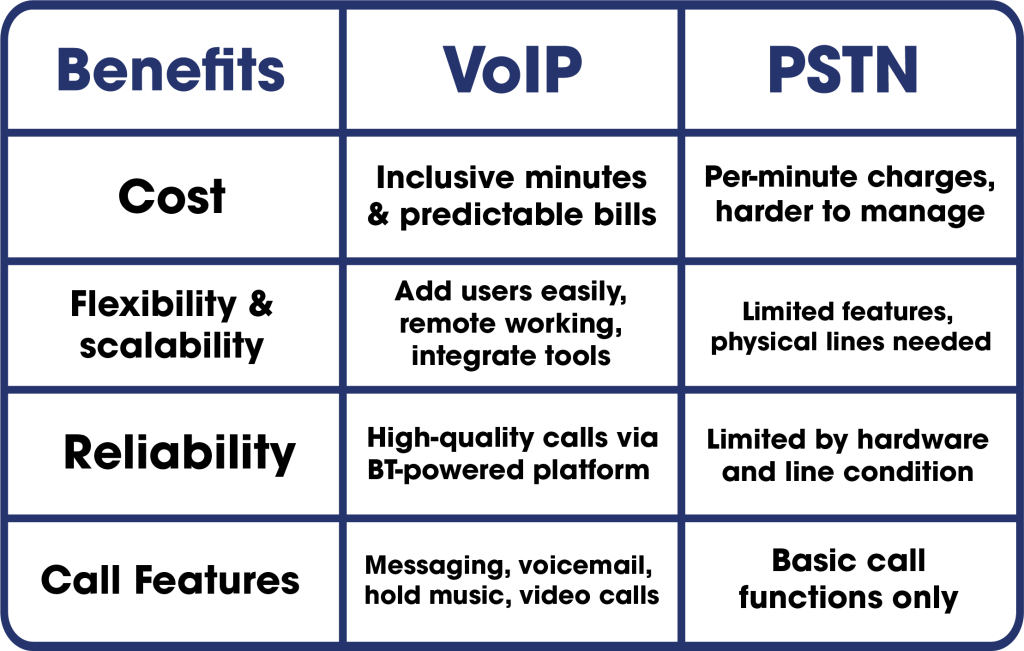
VoIP isn’t just about cost, it’s about giving your team the tools to communicate efficiently, anywhere, anytime.
Future-Proof Your Business with Mobile VoIP
Why Mobile VoIP?
Mobile VoIP combines the benefits of cloud telephony with mobility, flexibility, and reliability. It’s perfect for teams that need to take business calls anywhere without compromising professionalism.
Key Features:
- Unlimited Inclusive Minutes: Predictable monthly costs, no surprises
- Improved Mobility: Take calls from desktop handsets or mobile app
- Plug & Play Handsets: Simple setup with Power over Ethernet; easy to relocate
- Crystal-Clear Quality (QoS): Reliable calls backed by BT Wholesale infrastructure
- Handset Warranty: Peace of mind with covered hardware
Business Benefits:
- Cut unnecessary landline costs
- Maintain professional customer communications
- Scale easily as your team grows
Mobile VoIP is smarter, flexible, and future-ready, making it ideal for businesses preparing for the PSTN switch-off.
Product Spotlight: Mobile VoIP
With the upcoming PSTN and ISDN switch-off in 2027, now is the time to move your business communications to a smarter, more flexible solution. Our Mobile VoIP service delivers reliable, cost-effective calling – powered in partnership with BT Wholesale for trusted quality and performance.
Unity Mobile VoIP provides:
- Reliable, cost-effective calling
- Flexibility to work from anywhere
- Easy-to-manage hardware
- Fixed monthly costs for predictable budgeting
It’s a complete business communications solution built for today’s mobile, hybrid, and cloud-first workplaces.

Ready to future-proof your communications?
Contact Unity today and speak to our team about getting started.
Ready to future-proof your communications?
Contact Unity today and speak to our team about getting started.
Other Articles & Blogs

How to Trust Your Software Developer with Your Cybersecurity
How to Trust Your Software Developer with Your Cybersecurity Why security needs to be built into every line of code—starting now. Software touches every part of your business. CRMs, accounting integrations, customer portals—all essential, all filled with sensitive...

Trusted Tech Brands for the Modern Network
Trusted Tech Brands for the Modern NetworkAs the workplace evolves, so does the way we connect. At this year’s Mobile World Congress, innovators like Ericsson and Acer revealed next-gen solutions designed for an always-connected workforce. But with progress comes...

Trust-Led VoIP: Shaping the Future of Business Communication
Trust-Led VoIP: Shaping the Future of Business CommunicationAs businesses adapt to remote work and prepare for the PSTN/ISDN switch-off, Voice over Internet Protocol (VoIP) has become more than a communications upgrade—it’s a foundational tool. But in 2025, one...